In every corner of the advertising industry, we’re having versions of the same conversation: what’s our agentic strategy? Is agentic commerce going to disrupt everything about ecommerce? In what way? And how soon? While there is a lot of legitimate excitement about exploring new capabilities and ways to interact, there is also an undercurrent of worry, which is understandable due to how much uncertainty there is in this space, and how quickly the underlying technology is changing.
I've spent a lot of time in those conversations over the past year with our brand and agency partners. This includes everyone from established CPGs managing large, multi-category portfolios to challenger brands that are breaking through on the democratized digital shelf of ecommerce. I’ve shared my own excitement about what generative AI technology is enabling us to do behind the scenes and in new consumer- and partner-facing experiences. But I’ve also been honest: nobody knows precisely how the industry is going to change or which new shopping behaviors will gain traction at scale.
What this means is that we have a tremendous learning opportunity in front of us. The best approach is for us to be open, curious, and enthusiastic. We’ll learn what’s resonating and will be ready to experiment and pivot to what’s working. And most importantly, we all need to remember that the fundamentals still matter: products that consumers love, authentic discovery moments, and features that add value for customers and advertisers alike.
With our AI-powered shopping assistant, built directly into the Instacart Marketplace, we're bringing a new conversational shopping experience to millions of customers. But we're not launching ads within that experience today, and that's by design. While we of course have ideas about what will resonate, we are going to shape sponsored content around how consumers engage with this new AI surface, what they love about it, and what becomes habit.
This gets back to the root of advertising: consumer experience comes first, because advertisers will always want to be where their consumers are and show up in an engaging way. At its best, advertising is additive to the consumer experience.
That's always been our ethos at Instacart. We've built our advertising ecosystem deliberately, experimenting alongside our brand partners, validating what works, then scaling it. As revolutionary as this new technology is, we’re going to apply those same fundamentals here. I believe that taking this approach will help us separate real traction from hype and help transform anxiety into excitement.
We've navigated big moments of change before
We have a reason to believe that this approach works because we’ve needed to adapt to new consumer behaviors and surfaces throughout the evolution of retail media and Instacart Ads. We’ve already navigated disruptive moments together.
Instacart sits at a unique intersection: thousands of retailers, millions of products, and billions of shopping interactions, all flowing through a single platform. This scale of our data powers an intelligent foundation that no single grocer or brand could build on their own. This is what has allowed us to keep finding new ways to connect consumers with the products they need, and brands with the moments that matter. It's also exactly what positions us well for what's coming next.
Back in the early days of Instacart Ads, we started with sponsored products – a straightforward, native way to help brands gain visibility on the digital shelf where consumers were actively searching and shopping. Then we added display ads to reach consumers earlier in their discovery journey. We followed this with more opportunities to inspire: shoppable video, sponsored recipes and occasions, brand pages, and more, because we saw that consumers were responding to opportunities to discover beyond their chosen aisle. We then expanded beyond our own platform entirely, meeting consumers through retailer websites, in-store surfaces like Caper Cart, and off-platform channels like streaming TV and social media.
Each of those moments was, in some ways, a new frontier. And during each one, we didn't ask brands to start over; we looked at this as a next step in our journey. We asked: where are consumers spending time, and what do they need? How do we show up for them in a way that's useful? Then we built the tools to make it easy for brands to do exactly that – both by extending existing formats, and building new end-to-end capabilities. These are all now part of the Instacart Ads ecosystem.
AI-native experiences – chat interfaces, conversational shopping, agentic discovery – are the next chapter of this story.
AI is already working
Before we talk about what's coming, it's worth acknowledging what's already happening today. AI has been woven into how Instacart works for years, in how we rank and personalize results, how we curate content, and how we help brands measure and understand their campaigns. Much of this runs quietly in the background, powering experiences across our partner tooling and consumer surfaces.
One of my favorite examples is our suite of AI-powered recommendations in Instacart Ads Manager. We’re able to look across your campaign settings, performance data, catalog health, and competitive dynamics to understand how you can improve performance and campaign delivery. Thanks to AI, we can synthesize this all into actionable recommendations that you can adopt with a single click.
Behind the scenes, we’re using cutting-edge technology to improve the relevance and cohesiveness of our sponsored recommendations. Using LLMs, we can understand even more deeply how products connect to each other. This allows us to predict more complex purchasing patterns, like the tendency for people who add salmon and lemon to also add dill.
These initiatives, alongside many others, are designed to help brands of all sizes achieve their campaign goals and show up for consumers at moments that will resonate, driving valuable outcomes with less manual work.
So when people ask me if AI is going to change advertising on Instacart, I tell them it already has.
AI-powered shopping: a new surface, the same mission
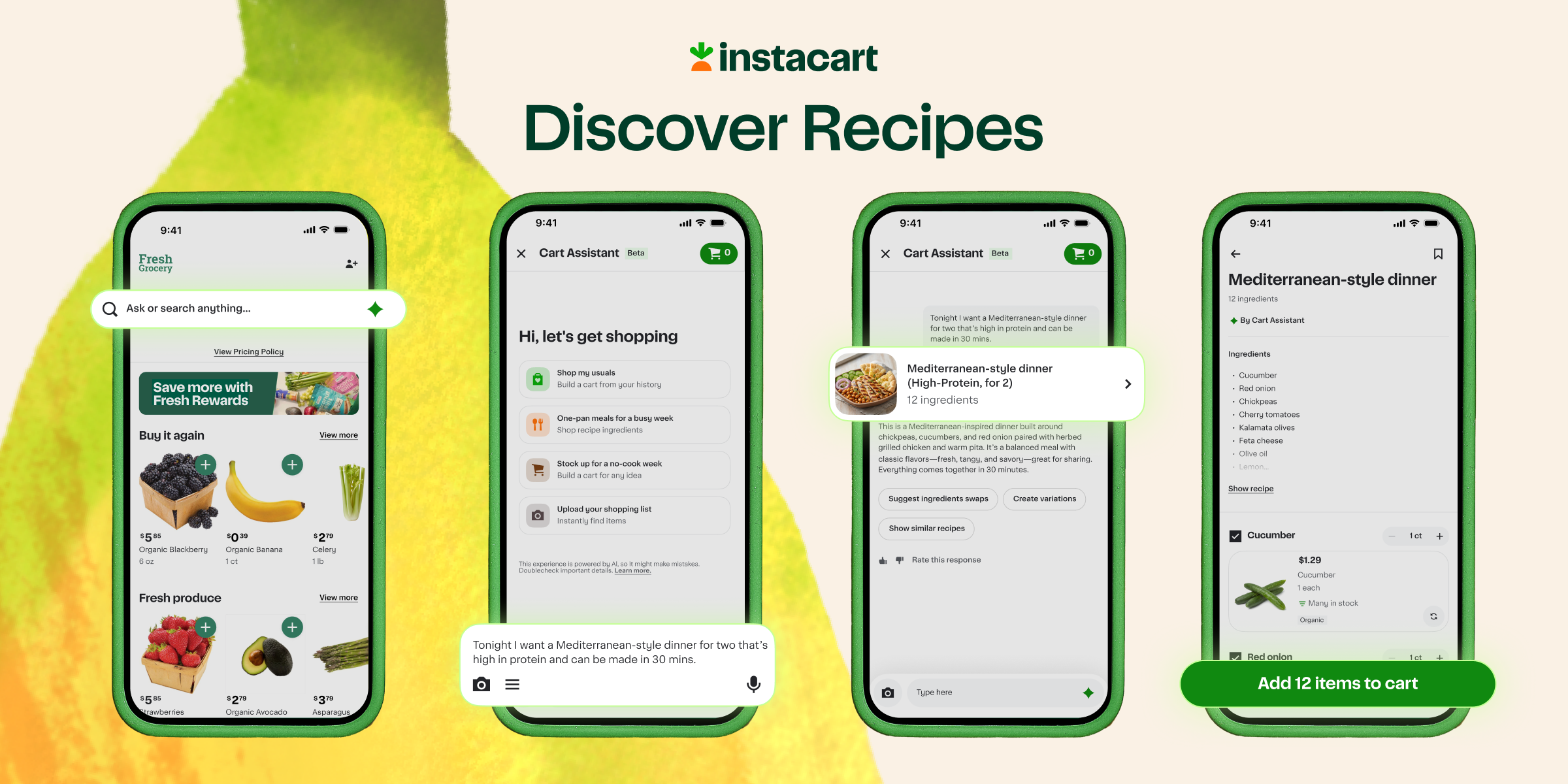
With our AI assistant, consumers can plan meals, explore recipes, build their baskets, and get help with open-ended questions to decide what to cook tonight, how to feed a family with mixed dietary needs, or which product to buy.
Consumers have become used to translating their needs into specific search terms and lists before they even start shopping. Now, they can express more complex needs. This creates an exciting new entry point to engage with consumers while they’re most open to discovering something new. When combined with the structured data of Instacart’s in-depth catalog, personalization signals, and purchase history, this experience can feel truly magical.
Our AI assistant ties into the broader goal to enable personalized discovery for grocery wherever consumers are starting their journey. This is what will shape our monetization strategy for these new surfaces: Which use cases are resonating? What does the consumer actually want from a conversational grocery experience? What would make an ad feel truly useful and additive, rather than intrusive? Based on what resonates, we will have valuable signals to help shape our ads strategy. And just like we’ve always done, we’ll experiment and iterate based on what we see is working for consumers and advertisers alike.
That said, I can’t resist sharing a few early concepts that are likely to be the first types of experiences we test, building on early signals from our AI assistant
Sponsored recipes and occasions: building on what we already offer advertisers today, we could provide answers to natural questions for consumers to ask in our AI assistant. When someone asks for gluten-free recipes for three people that can be ready in under 30 minutes, we could surface a garlic bread recipe by a gluten-free bread brand.
Offers and deals: brands today already use coupons, full-size sampling through our “free gift” product, and basket-building offers to help consumers “stock up and save.” Surfacing these deals as consumers look for savings opportunities could offer meaningful value while also supporting trial and cross-sell.
Product exploration: one of the most fun parts of grocery shopping is discovering something new. For consumers who might want to explore the latest trends in functional beverages, brands could reach them with sponsored recommendations in a carousel of gut-friendly sodas.
These deeply engaged experiences can provide a strong foundation for valuable reach and results, while feeling natural and non-interruptive to consumers because they align so closely with organic intent.
Building on these early concepts and consumer usage and feedback, we plan to start testing ads in our AI assistant over the second half of this year. As always, we’ll build and iterate in close partnership with our brand, agency, and API partners.
Your partner for what comes next
Nobody has a definitive answer on how agentic commerce will land with consumers at scale yet. While technology moves quickly, it takes time for consumers to discover and adapt to new ways of shopping. That's true for us, and it's true for everyone making bold declarations right now. This is a moment for enthusiastic adoption, testing, and learning – not certainty. The right partners at this moment are the partners who want to test and learn together, building on top of strong foundations.
In grocery, Instacart is the right partner for this moment. Backed by 14 years of grocery expertise, we’ve built strong foundations around purchase data, catalog breadth, partnerships, and a commitment to drive utility and performance across our ecosystem. We’re embracing new technology both for our Instacart marketplace and across our ecosystem, helping consumers discover and purchase in new and richer ways.
Our mission with Instacart Ads stays the same: help brands connect with consumers to discover products they’ll love. Regardless of where consumers are spending their time – actively shopping online, browsing social, watching streaming TV, or walking through the aisles of the grocery store – we can shape advertisable moments that feel additive, relevant, and drive value.
With agentic shopping, we’re ready to do it again.
This blog post contains forward-looking statements within the meaning of the Private Securities Litigation Reform Act of 1995. All statements other than statements of historical fact could be deemed forward-looking, including without limitation statements regarding anticipated product developments. These forward-looking statements are subject to known and unknown risks, uncertainties, assumptions, and other factors that may cause actual results or outcomes to be materially different from any future results or outcomes expressed or implied by the forward-looking statements, including those more fully described in Instacart's filings with the Securities and Exchange Commission. Except as required by law, Instacart undertakes no obligation, and does not intend, to update these forward-looking statements.